I have just finished my every quarter-century reread of The Lord of The Rings. This was prompted by Madeleine Dombrowski, at her excellent

Love of Literature Substack. Beginning last year, every few months Madeleine hosted a slow reread of each of the three volumes of the novel, and supported a weekly comment section complete with question prompts. This focused my thinking somewhat, especially on the moral questions and moral values at the center of Tolkien’s work.
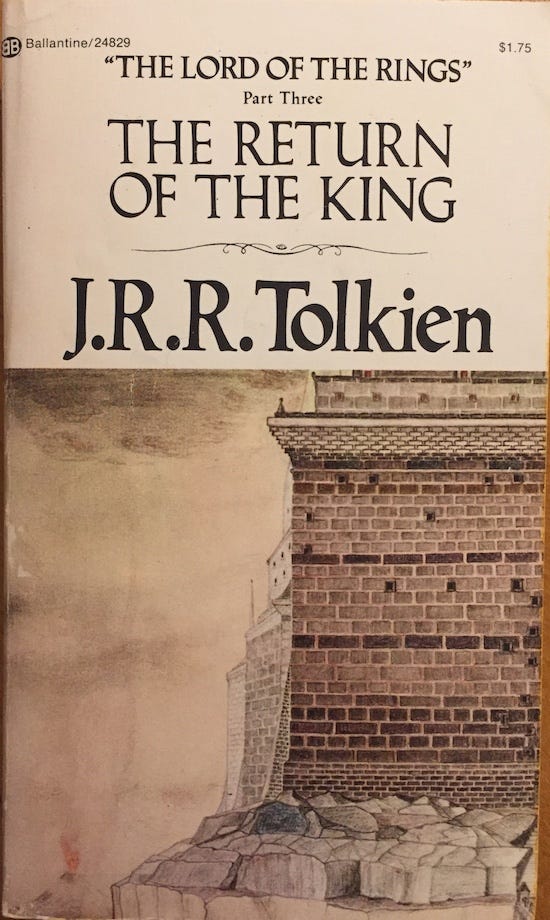
I found this a very satisfying reread. As noted above, I seem to reread The Lord of the Rings every 25 years. I read it first in high school, when I was 15 or so, via the trilogy I bought in a boxed set of the Ballantine paperbacks via a school sale. I reread it when the movies started coming out, in 2001. And last year and this year was my next reread -- and I am now just shy of 67. I still find the books very entertaining, and profoundly interesting in that moral sense mentioned above.
I’ve already discussed my latter-day reactions to The Fellowship of the Ring and The Two Towers. Below is a somewhat impressionistic look at The Return of the King, guided in part by Madeleine’s questions. I won’t spend much time on plot summaries, nor will I worry about spoilers -- I assume that most of my readers will have read the books or at the very least will have seen Peter Jackson’s movies.
I’m going to organize these reflections beginning with the excitement I felt, and the feeling of joy (or reflected joy) that was transmitted in the novel, and then cover some more or less random thoughts about various characters, and sum up with the ending.
Joy, excitement, Eucatastrophe
Gandalf shows little joy overtly, but I think he retains the ability to find joy in small things even as the great things are so darkly tinged. (Later in the book of course he shows very great joy indeed -- but for certain characters in the novel -- maybe for all of them -- that joy is ever combined with loss, with regret, with sorrow, with memory of what they have been through. Perhaps this is one of the great themes of LOTR.)
What condition is needed for “Eucatastrophe”? One of the most important is maintaining hope. Denethor’s final despair is his greatest sin. Eowyn’s hope, and Merry’s, and Theoden’s, puts them in position for a triumph, and for “Eucatastrophe”.
I have to say first that these chapters (the climax of the first half of The Return of the King) are the most thrilling chapters in all of The Lord of the Rings. We think much -- and rightly so -- about the deeper themes in the books, the sacrifices the characters make, the moral lessons, the regret for a passing world, the beauty. All of this is important and makes the books great. But there is also good old adventure writing, excitement, deeds of valor. And that comes to a climax in the ride of the Rohirrim and the battle of Pelennor Fields, and of course when Eowyn (and Merry!) confront the Witch King. And, yes, Eowyn’s triumph is a moment of “Eucatastrophe”, and it makes me cheer and brings tears to my eyes.
As for tears -- I was reminded as John Crowley, an exceedingly great and somewhat underappreciated writer, died recently, that over and over while reading his work I am driven to tears. I am driven to tears just thinking about some of his stories. And those tears are only sometimes a response to a tragic event -- very often pure beauty brings me to tears, or awe, or something bittersweet, or a Eucatastrophe. Tears are how our body responds when our brain (and heart) overflows.
Denethor
On this reread Denethor struck me as a deeper, more tragic, character than I remembered (I blame the movie!) He truly seems to have been a noble man, and at first a good Steward, in what seems to have been a long tradition of good stewardship. And he does have a deep mind, and great perception. He has been worn down -- by age, by the great shadow Gondor has been under -- eventually by despair. And by the loss of Boromir, his clear favorite son. In the end, I feel that he originally had his people’s interests in mind, but was corrupted -- in part by his own weakness (resentment that he was not King but Steward) and then by Sauron, and the fear Sauron instilled. And so he was, I think, saving himself (in a way) rather than his people, and especially the wider world.
Eowyn
Eowyn is one of my favorite characters. Besides her -- is it fair to say “infatuation”? -- with Aragorn there is clearly great respect, great envy almost, for him. If we can call him a Christ figure, perhaps she does not understand that her “love” is not the same as, oh, call it “Eros”? In this crisis, she sees only the importance of battling Sauron, and she desperately wants to be allowed that ... she does not quite see that “they also serve who only stand and wait” -- though this “waiting” is not simply “waiting” , it is true service.
Eowyn, Theoden, and Merry face the same peril Denethor sees -- they know that they are likely to lose, indeed likely to die. But they turn away from despair. Eowyn’s triumph (and Merry’s role in it) are examples of the (apparently) less powerful facing a great power bravely. And they show that power is not merely physical -- it is moral. (This is a repeated theme of course -- it is why Faramir is in the end stronger than his brother, for example.)
Eowyn’s hurt is, as Aragorn notes, beyond physical. That wound athelas can heal, but she still must shed her personal cares -- her misguided (though not exactly wrong) feelings about Aragorn; her insistence on a warrior’s role even if it is not the greatest need; her restlessness. In some ways Eowyn is hurt in a fashion reminiscent of Frodo’s enduring wound, and yet she can be cured.
Aragorn
Is it too simplistic to say that the White Tree’s withered state reflects Gondor’s withering -- perhaps under the “shadow” (plants without sun will wither), perhaps because without a true King there is no renewal, no true nourishment?
Aragorn arriving from the “Paths of the Dead”, indeed from a cave, does echo the Resurrection -- but only echoes it: he is a great figure, but he is not Christ. The other symbols: Elessar (Elfstone), the flag of the White Tree, the star of Elendil ... all this speaks of restoration, the restoration of Gondor. (I admit that his taking, a bit later, a version of his name “Strider” as the name of his line to come made me happy. (We named our dog Strider, when we adopted him about as the movies came out.))
Aragorn’s speech seems more elevated, more formal. (Lots of verily’s!) I believe he meant to assume the responsibility/burden of his Kingship, and his speech reflects this. Oddly, he sort of fades away as a character as the novel closes.
Frodo
I do think Tolkien (in a letter to a reader) is quite correct that Frodo’s “failure” to voluntarily surrender the Ring was the only logical conclusion. (Now, the ending could have been Frodo dying along with Gollum in the struggle -- that is, in a way, what Frodo expected. I think Frodo’s survival is important structurally -- his continued struggles, his eventual journey to the West, are thematically valuable. But the battle would still have been won had he died.) Frodo failed, surely, but he did all it was humanly (hobbitly) possible to do, and he did bring the Ring to the place it could be destroyed, against terrible odds. So he is still a hero.
I don’t think I ever, even on my first reading as a teen, doubted Tolkien’s choice in that last struggle between Gollum and Frodo. It seemed -- still seems, even more so -- the narratively correct result, and the morally believable conclusion. Critics of Tolkien sometimes claim the story is a simplistic good vs evil story, and it is no such thing. There is good in Gollum, evil in Frodo, in every mortal. And the story powerfully shows us this.
Frodo’s use of “doom” seems to me to be related to “fate” or “destiny”, in a sort of Norse sense. It is a burden placed on him that he cannot escape, though the end may not be “doom” in the sense of “death”.
Frodo’s unhealing wound seems wholly appropriate. Does it come from the wound he received from the Nazgul? From his extended bearing of the Ring? From the weariness and stress of his journey? From some feeling of guilt that at the end he hesitated, and only Gollum’s desperate attempt to steal the Ring led to success? I’d say, all of the above.
I also think in some sense Frodo feels alone. (Perhaps his aloneness versus Eowyn’s eventual marriage to Faramir is why Eowyn could find the healing that Frodo did not.) Even Sam does not truly understand what he went through. He feels that there is no future for him in Middle Earth, in the Shire. He has, in a sense, no home -- and never has had one since Bilbo left. He has no family, I think. One aspect of the “good life” that we see Sam living is family. I don’t want to say that that is a necessary condition for a “good life” for everyone, but it is for many people.
Sam
Sam’s ability to resist the Ring is interesting. He DOES use it, and it DOES help. But at the same time he sees its danger, represented by the loss of pure sight. At some level he realizes that the Ring isolates one from the real world, from truth, and from what he treasures most -- his companions, and Frodo in particular. I think it is this devotion to his world, his lived-in world, that saves him from the Ring. And in the end, sadly -- Frodo finds that he has become separate from his community, and the only cure for him is to go to the West -- which is ultimately a sort of isolation.
I think Sam’s plea -- to the Lady -- for water and light perhaps functions like a prayer to a saint -- Galadriel herself does not have the power to grant prayers, but perhaps to act as an intercessor?
That lovely passage about hope, when Sam sees the star, is surely an example of hope coming from a reminder that there is beauty in the world, and that there is something greater than whatever terrible place you might be. In this sense his hope is buttressed by recognizing and remembering this fact -- while his defiance was a case of internally insisting that there must be a way, even without a visible signal.
I don’t think acceptance of death need be despair. We all will die, Sam knows he will die, and if there is nothing further he can do, and knowing that his great mission has been achieved -- there’s a nobility in accepting it. Without actively seeking it!
The Scouring of the Shire
This segment is vitally important. It reminds us that War affects the home front, too. It reminds us that some evil is present in all of us, and we must take care not to yield to it. And it emphasizes mercy as well -- Frodo’s desire, in particular, that no one be killed if possible.
That said, I felt just a bit, this time through, that it was too easy. The actual work of reclaiming the Shire from Saruman’s minions and collaborators would have been harder, I think -- would have taken longer. For novelistic reasons, it would be hard to fully show that though. I also think that Tolkien’s exaggerated hate of any sort of advanced technology (like streetlights!) is present here, and tonally misplaced. Saruman and his minions are terrible people, and their rejection and corruption of beautiful old things is a terrible wrong, but the implication that ANYTHING new would be awful is unfair.
The Closing
I feel that the extended denouement of The Lord of the Rings is actually very worthwhile, even if the novel’s pacing hiccups somewhat towards the ending. And the final resolution, so mixed with almost reluctant triumph, and so much regret, so much loss, is brought out powerfully. The Third Age is passing, and that certainly involves the departure, the senescence, of much beauty. But the Age to follow should be seen as an Age of promise too.
The final three or four pages are sublime. So many lines or scenes bring tears to my eyes:
“I have quite finished, Sam,” said Frodo. “The last pages are for you.”
The whole paragraph beginning “Though they rode through the midst of the Shire” and ending “and so they rode down at last to Mithlond, to the Grey Havens in the long firth of Lune.” is just beautiful.
“the grey rain-curtain turned all to silver glass and was rolled back, and he beheld white shores and beyond them the green country under a swift sunrise.”
And of course the magical ending: “Well, I’m back,” he said.
Link to my earlier discussion of The Fellowship of the Ring:

A wonderful review, thank you, and now I’m a bit teary.
Have you read Michael Swanwick’s essay on re-reading LOTR at different points in his life?