A Sharp Historical
The Gipsy in the Parlour, by Margery Sharp
Margery Sharp has long been a favorite writer of mine. As a child I read her Miss Bianca books (beginning with The Rescuers, which became a Disney movie) and as a teen I encountered novels like Cluny Brown and Something Light, and I loved them, with no notion that their author was also the author of The Rescuers. I continue to read her adult novels as I come across them. For some time this meant scouring used book stores, but since 2018 a number of her books have been reissued, by both Open Road and by the Dean Street Press imprint Furrowed Middlebrow.
Sharp is one of the great midcentury women writers from the UK in whom I delight, though I’ve long thought she was not given the respect she deserved compared to some of those others -- and I have also suspected that this derived from her relative commercial success during her lifetime, and also perhaps from her reputation as a children’s writer. But in my view she’s wholly the equal of the likes of, say, Barbara Pym. I was delighted to find just now an encomium for her in the New York Times, written by Perri Klass upon the republication of ten of her adult novels by Open Road, in which she is compared to Pym and also to Elizabeth Taylor. (As Klass archly notes, the “other” Elizabeth Taylor starred in a movie based on Sharp’s excellent novel Britannia Mews.)
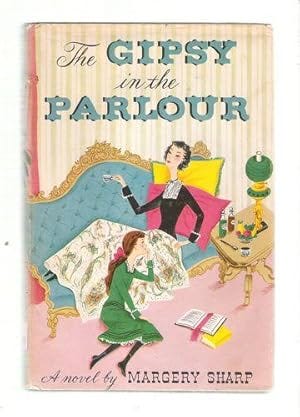
My latest Sharp novel is The Gipsy in the Parlour, from 1953. My edition is the US edition, presumably the first, from Little, Brown. (The most recent reprinting retitled the novel slightly as The Gypsy in the Parlour.) (And I’ll add that the title character is not, as far as one can tell, Romany at all.)
This novel is told from the point of view of a young girl, aged 10 when the story begins in 1870. Her narrator voice is placed some decades in the future -- as the final line of the novel goes “It all happened, this whole story, a long time ago.” This never named girl is the daughter of a London lawyer, but summers at the Devonshire farm of her four uncles, Tobias, Matthew, Luke, and Stephen Sylvester. But the men don’t really matter -- it is their wives who count: Charlotte, Grace, and Rachel. All big strapping beautiful blond women, loud, hard workers, women who know how to keep house, who know how to keep their husbands happy and in order. Charlotte chose Tobias, and subsequently chose Rachel and Grace for Matthew and Luke. But now Stephen has brought Fanny Davis from Plymouth, planning to marry her. She is small and dark, and pretty but in a very different way from the Sylvester women. Over the next month before the wedding, the narrator becomes Fanny’s “little friend” -- helping her adapt to her new home, and not quite properly noticing that some of Fanny’s ways aren’t quite -- right. The narrator’s school starts before the wedding is scheduled, so she must head back to London -- and as she leaves recognizes that Charlotte and Tobias’ son Charlie has arrived from Australia for a visit.
Many readers will guess the shape of the plot from there, but our narrator has no clue. She is shocked to return the following summer and find out that Stephen and Fanny’s wedding never happened. It seems Fanny fell ill -- into a “decline”, our novelette reading narrator imagines -- shortly before the planned wedding. She has been installed in the parlour, languishing on a couch all day, and Stephen and the rest of the family are patiently waiting for her health to improve. Once Fanny’s “little friend” returns, she is claimed (by Fanny) to wait on her constantly ... which puts a crimp that the narrator doesn’t seem to sense in her usual happy outdoor activities. And, indeed, the whole atmosphere of the farm has changed -- for Fanny in her illness can’t tolerate any sort of upset, including noise. And for the Sylvester women to be quiet is a hard thing indeed.
The narrator’s next return to London advances the plot further, for she encounters her cousin Charlie, by accident, in London -- and she also finds herself inveigled into delivering letters from Fanny Davis to Charlie. Charlie is living above a lower class eating house in a poorer neighborhood of the city, and the narrator makes friends with the handsome girl Clara Blow, who more or less runs the place. And what she eventually learns -- pretty much against her will! -- about Charlie and Clara and Fanny finally, once she’s back at the farm, precipitates a crisis in the whole Sylvester family.
As I said, I dare say most readers will have guessed a lot of this pretty early. And in that sense the novel fails to ever surprise, and indeed it drags a bit in the middle, as the reader finds themself way ahead of our narrator. I do think this a relatively minor work in Sharp’s bibliography -- but it is redeemed by a pretty majestic closing sequence. I enjoyed myself on the whole, and I loved the depictions of the Sylvester women (especially Charlotte), and also Clara Blow; and the narrator’s voice and her somewhat innocent (though informed by her later understanding) commentary is quite attractive. The conclusion -- fun and satisfying as it is -- has some rather convenient elements to it, though. And I will say too that coming to this novel, set in 1870-1872, directly after reading a Trollope novel set in the mid 1860s, that I wasn’t quite convinced by Sharp’s portrayal of that period. Sharp has often been better than here -- yet The Gipsy in the Parlour is still well worth reading.