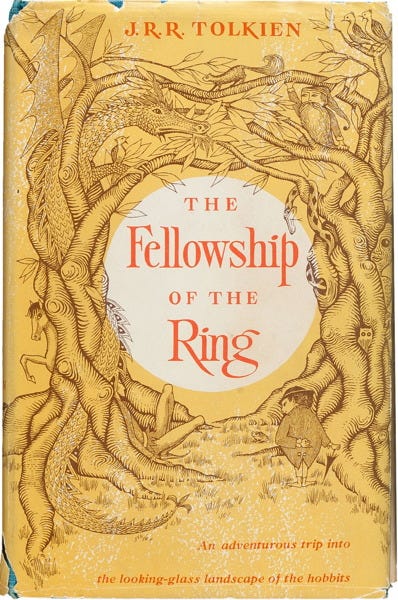
Reread thoughts: The Fellowship of the Ring
I recently finished my third read of The Fellowship of the Ring. (I will soon continue to The Two Towers and The Return of the King, of course.) It seems I am on a reading schedule for The Lord of the Rings of roughly once a quarter century -- I read it first at about age 15, and reread it when the movies were coming out -- I was 41 when the first of Jackson's trilogy appeared. And now I am 65. In all honesty, that seems like a reasonable schedule, and those seem like good ages for reading the books.
There is no point in any sort of "review", I think. Most people, I imagine, know the basics of the story -- indeed, almost anyone who would read my blog. I'll simply say that I still think it's a wonderful book, and a powerful one (and the same applies to the whole trilogy.) I'll simply give some thoughts, prompted in part by my age and experience; in part by the online book club I'm reading this with (hosted by Maddie Dombrowski at her substack Love of Literature); in part by fairly recent reads and rereads of some of Tolkien's other work, most notably "On Fairy-stories" but also the likes of "Leaf by Niggle" and "Smith of Wootton Major"; in part by memories of the movies, which I enjoyed and sometimes loved but which do not stand with the books; and in part simply the sort of things that do occur to one on any reread.

The Fellowship of the Ring is, obviously, just a third of a complete novel. This has never been concealed. As such, while it ends at a critical point ("The Breaking of the Fellowship"), there is not a true resolution. So, the book tells of the recognition of an imminent and dire threat to Middle Earth; then of the formation of an alliance among races -- Hobbits, Dwarves, Elves, and Men -- against that threat, leading to the establishment of the "Fellowship of the Ring", composed of members of each race; then a journey east and south, with a primary goal of helping Frodo, the Ringbearer, reach Mordor where he can hope to destroy the Ring, and a secondary goal (perhaps) of bring help to the nations of Men most immediately threatened by the Enemy (Sauron.)
That's a pretty bald description. The novel itself, of course, is largely a story of a journey. Really, of the journey of Frodo and Sam, from the Shire to Bree to Rivendell to Moria to Lórien and finally to Rauros, the great falls on the river Anduin. On this reading I noticed a structure, or an alternation of mood and action. The book begins in the Shire, with a birth celebration: a time of peace and relaxation. There follows, roughly speaking, times of action and peril, alternating wth times of rest. So -- the dangerous trip the hobbits make to Buckland, followed by the interlude with Tom Bombadil in the Old Forest. Then they make their way to Bree, meet Aragorn, and are chased eventually all the way to Rivendell, where again they are able to rest. After that the scary trip through the mountains, then down to Moria and through it until they emerge and come to Lórien and the Elves' home of Lothlórien. And in Lothlórien of course there is again a long rest. After which the trip down the river and the breaking of the Fellowship. These times of peace are refreshing of course, and also beautiful. To be sure, there is precious little chance for any of the characters to experience any peace during the next two volumes!
One of the constantly recurring themes in this book is that of regret for what is about to be lost. (This theme of course is fundamental to the entire trilogy, but it is already deeply present in the first book.) This is foreshadowed in the scenes in the Shire -- even in something so relatively minor as Frodo ceding his home to the Sackville-Bagginses. Also of course there is Bilbo's departure. And the time in Rivendell is suffused with awareness that it and its beauty will not last long. This feeling is even more intense, and made quite explicit, while in Lothlórien. I found all these passages quite affecting. Besides that, we really do see two portraits of loyalty and duty -- in both Frodo and Sam. Frodo's path is tortured -- he knows this essentially from the beginning, and surely after his wound that might remind us of the sword piercing Christ's side, and he wishes he did not need to carry the Ring, but knows he must. I don't think he's a Christ figure, but he does have that significant wound, and at times we see him, in essence, echoing Jesus when He says "Father, if thou be willing, remove this cup from me: nevertheless not my will, but thine, be done."
A brief note about two of the most ancient, and arguably most powerful, characters: Tom Bombadil and Galadriel. Both are essentially virtuous, and wise, and have significant abilities. Yet both -- in very different ways -- largely sit out the coming war. (Perhaps this isn't quite fair to Galadriel, who did provide assistance, and counsel, and eventually some action during the final stages of the war.)
It's hard not to comment on the differences between the movies and the books, and I don't want to do so to any great extent, but it's very noticeable how different Gimli's character is in the books versus the movies -- entirely to the detriment of the movies, which insist on making him a comic foil. On the good side, though, I'll praise the movies' visual presentation of both Rivendell and Lothlórien, and also of the Argonath, the statues of the Great Kings -- the moment they are sighted towards the end of the first movie is quite thrilling.
Here are a few more thoughts about the book, mostly involving favorite quotes:
I strongly suggest reading the prologue, "Concerning Hobbits", which I suspect is often skipped. It is delightful, and quite funny at times. And this continues in the first chapter. I think Tolkien's depiction of the Shire is pretty consciously a (perhaps idealized) version of rural England, in perhaps the 18th Century. (I was reminded slightly of the "South" part of Elizabeth Gaskell's North and South, though of course that's set in the middle of the 19th Century.) It's a depiction of a generally happy society, somewhat classist (in a way that Tolkien seems to approve of), without machinery as such. It's meant to be pleasant but static. And the people are people, with jealousy and small-mindedness as well as generosity and love -- but on a small scale, constrained. This is surely a deliberate contrast to the rest of Middle Earth, and Tolkien is starting there in order to a) give us (and the hobbits) something to yearn to preserve; but also to give us a bucolic backdrop in order to contrast with the horrors to come -- but also to contrast with the great heroism to come.
A quote about immortality: "A mortal who keeps one of the Great Rings, does not die, but he does not grow or obtain more life, he merely continues, until at last every minute is weariness ..." this struck me immediatly as a very wise statement. We have already seen it in Bilbo, and I think we see it later beginning to affect Frodo. (There are many science fiction stories about immortality -- some of which don't think deeply about the eventual effects, but many of which do come to similar (if less spiritual) conclusions about its effects.)
Sam, speaking about the Elves: "They seem a bit above my likes and dislikes, so to speak. ... It don't seem to matter what I think about them. They are quite different from what I expected -- so old and young, and so gay and sad, as it were." This quote reminds me of Tolkien's complaints (in "On Fairy-stories") about the representation of fairies in children's literature of 19th and early 20th century: small, twee, silly in many way. Tolkien's Elves are proper inhabitants of Faerie as he sees it.
I wonder about the "fallenness" (in Christian terms) of the Elves in Lothlórien. It's hard for me to accept that they are not "fallen". But, unlike humans (and of course hobbits) they don't seem to face the threat of normal death through age. That is, clearly, a mixed blessing. And perhaps it means they will not have true immortality in heaven? (Note Tolkien's comment in "On Fairy-Stories" that perhaps when Fairies hear "human stories" they like to hear about "escape from deathlessness".)
Finally, two quotes about Galadriel from close to the end of The Fellowship of the Ring:
"She seemed no longer perilous or terrible, nor filled with hidden power. Already she seemed to him, as by men of later days Elves still at times are seen: present and yet remote, a living vision of that which has already been left far behind by the flowing streams of time."
"As they passed her they turned and their eyes watched her slowly floating away from them. For so it seemed to them: Lórien was slipping backward, like a bright ship masted with enchanted trees, sailing on to forgotten shores, while they sat helpless on the margin of the grey and leafless world."
(Subscriptions remain free)
In some of his later writings Tolkien tried, not very successfully I think, to square the circle on the elves by suggesting that although they could be individually sinful - even murderers - they never fell _as a race_ because they never followed or worshipped Morgoth.